THE flower beds in East Grinstead’s historic High Street will be planted this year in tribute to the victims of the Whitehall bomging which took place 70 years ago.
On 9 July 1943 ten German aircraft entered English airspace over Hastings and headed on a bombing run to London.
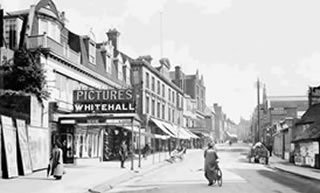
At 5.05pm the air raid sirens sounded in East Grinstead. It was teatime and the Whitehall Cinema in the London Road had an audience of 184 people, many of them children, who were watching a showing of Hopalong Cassidy after school.
A warning was flashed up on screen but few of the audience took any notice of it and remained in their seats.
At 5.10pm one of the German planes lost contact with the others and the pilot decided to find another target before he returned home. He fired on a train entering East Grinstead station, then circled the town twice before dropping his load on the town centre.
One bomb hit the cinema, others landed on shops in the High Street and London road, killing 108 people and seriously injuring 235 more.
It was the largest loss of life in any WWII air raid in Sussex.
Spartacus Educational quote the following eye witnesses to the raid which left dozens of local residents with lost limbs, disfiguring burns or mourning the loss of their children.
Mrs Pope lived in London Road, East Grinstead, during the raid. Her account appeared in the local newspaper a week after the incident.
“I was standing in front of my door when the plane came over the house-tops. I saw the bombs drop and I shouted out, ‘he’s bombing the cinema’. Then there was an explosion and I saw the cinema had been hit. The plane went away, circled round the town and came back straight towards me. It opened up with its machine-guns. My husband fell flat on the garden path. Bullets went over his head and knocked chips off the opposite wall.”
In 1945, T. P. Peters, an Air Raid Warden in East Grinstead, wrote about his experiences during the Second World War in his book, Reminiscences.
“I was in Norton House when the alert went. I said to Mr. Towler, Head Warden, ‘I will just check up on the shelters.’ I had just left the back of the Scotch Wool Shop and got to Bridgland’s when the bombs dropped. I was blown across the road into the building opposite. My mind soon cleared. I looked around – people were lying all round me terribly injured, blown from I do not know where. I was the only uninjured person present. Bullets were flying round as the raider had returned and was machine-gunning the town.”
Mrs C Putterick was working at the East Grinstead Post Office during the raid. She was interviewed about her experiences in 1993.
“We were working in the telephone exchange when the air raid warnings were given out. Scarcely had it been passed than we heard the sound of the plane diving down on us. There was a sound of an explosion, windows rattled and the whole room shook. Every light on the switchboard suddenly started flashing and it was impossible at that time to know exactly what had happened. We were scarcely able to breathe because of our anxiety.
East Grinstead Courier 16 July, 1943
Death dealing blows were struck at the heart of a quiet South-East town soon after 5 o’clock on Friday, when one of about ten enemy raiders swept in from the coast to cause havoc in the shopping centre, and a large number of casualties among men, women and children. The majority of the casualties were in a cinema, where a bomb scored a direct hit. It was there that the death toll was heavy.
Within a few minutes of this ruthless attack on an open town, Civil Defence workers, including police and the N.F.S. as well as troops and members of the Home Guard, were on the scene effecting rescues. Members of the public also helped in the heroic task. The combined services accomplished many feats of skill and daring, and worked feverishly throughout the late afternoon and night.
There were many harrowing scenes as children and women were recovered from the debris. A newspaper office was used for a mortuary, and later the bodies were taken to a garage where they were left for identification purposes. Not half of the victims had been identified by Sunday.
The attack on this quiet little country town will long be remembered for the manner in which defenceless women and children were massacred, and the viciousness of the attack by the Nazi raider on a locality which had no military pretensions. The one high explosive which caused the greater number of casualties was that which penetrated the roof of the attractive cinema. It actually dropped among the cheaper seats, which were mainly occupied by women and children. The cinema, which had a seating accommodation for 400, was fairly full at the time. Most of the children in the audience had gone to the cinema straight from school, a regular Friday night ‘habit’ among them.
One by one, and two by two, pale faced and lifeless children were brought out of the ruins. Some were found almost naked with their clothes blasted from them. It was a sickening scene, one which brought tears even to the stoutest hearts among the gallant lot of rescuers who toiled on through the night.
One man was told it was time to rest. The rescuer looked up, inwardly moved, but not betraying a sign of emotion, replied: “No, I work on. Under this rubble is my wife. I must find her.” And so he went on toiling. Also under the brick and dust was a worker’s sister-in-law. He dug her out and went on looking for her child.
Load after load of broken glass was swept up by soldiers and other Civil Defence workers and carted away out of sight. By Saturday morning those hard workers had cleared much of the debris. And while many worked on to make the road less like a shambles, there were several shopkeepers who were actually doing business with customers on the pavements instead of their damaged shops. One young woman was taking orders for delivery of groceries that morning. The order included cheese and streaky bacon. This had to be served up from the bombed shop. In the afternoon there was a sad queuing up of relatives at the garage
John Parsons, aged 13, was in the Whitehall Cinema during the air raid. He was interviewed about the raid in the local newspaper a week after the incident.
“I went to the cinema straight after school with a friend. We saw the news and while a cowboy film was showing the bombs fell. I was sitting in the front row – in the ‘tenpennies’. The first thing I knew was a sort of crackling which ran along the ceiling. The exit lights and the film went out at the same moment and the place was in complete darkness. Bits of debris started flying about I got on the floor in less than a second. I crawled along in front of the seats, jumped up and ran to the exit. Just as I was going up the steps there was an explosion. Then I felt a pain in my face and found I had been cut. When I came out I heard machine-gun fire and I stepped back inside again. When the firing stopped I left the cinema.”
East Grinstead Observer 17 July, 1943
Late on Friday afternoon a small number of enemy aircraft crossed the Southeast Coast. Bombs were dropped at different places. Two enemy bombers were brought down – one near Caterham and one near Sittingbourne – and both exploded, the crews being killed. A county town in the Southeast area was attacked, and a cinema was hit, causing a large number of casualties, including many children.
Suddenly the roar of a plane approaching the town from the north was heard. It swooped down out of the low-lying clouds and it was then that shoppers and other people realised that the twin-engined bomber was a German. It roared over the town, circled twice and then dropped several bombs. One made a direct hit on a cinema, another on an ironmonger’s shop higher up the road, another on a builder’s and ladies’ outfitters and one fell near a factory.
In the cinema was an audience of 184 – the majority being children – who were trapped when the bomb fell. Following the news came a cowboy film, during which the usual notice of an air raid being in progress was displayed, so that anybody who wished to leave might do so. Few people left, but among them was one schoolboy.
Suddenly there was a terrific crash, and to use the words of one survivor, the whole building seemed to collapse like a pack of cards, trapping most of the audience.
Molly Stiller, daughter of an officer in the Home Guard, was the only member of the cinema staff to be killed. She worked in the cinema as an usherette. Mr. Herbert Brackpool was busy in his bakehouse making jam tarts. Suddenly the roof split open and through the opening fell the bodies of four women. All four were dead. Mr. Brackpool, knowing that his son was at the cinema rushed to join the rescue workers. Presently one of Mr. Brackpool’s colleagues came across the boy’s dead body.
A little further up the road from the cinema, a large ironmonger’s shop received a direct hit and a fire spread rapidly. The company secretary had a miraculous escape. He was near the top of the building which was four stories high when he suddenly felt himself falling. He went through two floors before coming to a rest. He was able to cling to a ledge – behind him another room was blazing – until rescued by ladders.
The fire spread rapidly to the adjoining premises on the south-side, a cycle shop and the jeweller’s, which, like the ironmonger’s was gutted by nightfall. Further destruction was wrought in another street where some old buildings stood. A small millinery shop received a direct hit and collapsed killing the manageress. A builder’s premises next door was burnt to the ground and a ladies’ gown shop was wrecked. A number of members of staff were killed or injured.
Another bomb dropped to the rear of a stationer’s shop – one of the oldest buildings in the town. The proprietor and his wife have since died from their injuries.
The work of all branches of the Civil Defence was magnificent. Shortly after the bombs fell the N.F.S. were on the scene pumping water on the burning buildings. They managed to save a public house and a warehouse from total demolition and by nightfall they had the fires under control. Rescue squads, assisted by soldiers, members of the Home Guard, Special Police, and many ordinary citizens went straight to their task and worked grimly throughout the night. Mr. Frederick Whales, a railwayman who is also an air raid warden, unearthed the body of his niece, Molly Stiller.
E.G. Outsell, a sergeant of the special police, reported for duty despite the fact that he suffered injury by a machine-gun bullet. He was outside his shop when the plane machine-gunned the town and received a graze across his stomach from a bullet. After treatment he went on duty. Special Constable Golding was in a train that was machine-gunned and on his arrival home he found that his daughter had gone to the cinema for the first time for many months. Despite his great anxiety he reported for duty and later was relieved to hear that his daughter, except for cuts and bruises, was safe. Special Constable Prodger was on duty throughout the night knowing, too, that his daughter was in the cinema. She was among the killed.
Eric Parsons escaped from this ordeal because of his interest in rabbits. “I go to the cinema every Friday evening” he said. “This was the first Friday I have missed for months. Instead of spending my money on the pictures I saved it in order to enter my two rabbits in our school rabbit show.”
(7) Robert Jack, an agricultural worker, was in Whitehall Cinema during the air raid. He was interviewed about the raid in the local newspaper a week after the incident.
I had been given permission to take the afternoon off after completing certain errands, and for want of something better to do I went to the cinema. I took a seat at the rear of the hall. I had missed the opening of the film and was wondering what the picture was all about when I heard the crash of a bomb which fell nearby. The audience became restive, though not in any way panicky, but the majority, including myself, decided things were getting a little hot and we got up from our seats. It was all very orderly and the gangways were filled with people making their way casually to the street. I suppose about half the audience were on their feet and half had decided to remain. I had just reached the door and had my hand on it when there was an awful crash and I had a glimpse of the whole cinema filled with smoke and flames. Then something hit me on the head. When I came to I was lying in a heap in a seat ten rows away from the door. My head was bleeding and I heard groans. I was able to drag myself away and collapsed in the arms of one of the rescue workers.
William Roy Henn, projectionist, Whitehall Cinema, interviewed in 1993.
“It was a terrible, terrible day. The auditorium of the cinema was the most awful sight I ever wish to see. It is still as vivid in my mind as ever. You never forget something like that Everything was on the move, walls were collapsing around me. I remember standing there shaking myself and wondering what was happening. I was completely blinded by dust but I could hear screams coming from the audience. People were crying and moans were coming from beneath the debris right under your feet. Bullets were ricocheting off the walls around me like something out of a Western film. I took cover in a hairdresser’s shop and flung myself to the floor. The main shopping area along London Road was like a battlefield, half a dozen bodies were lying in the road.
Chronology of events in East Grinstead on 9 July, 1943
4pm: Children leave East Grinstead Secondary School. Some of the children go to the Whitehall Cinema.
5pm: Ten German bombers approach Sussex coast. RAF sends up 16 fighters to intercept them.
5.05pm : Air Raid Sirens sounded in East Grinstead. Air Raid warnings flashed on the screen of the Whitehall Cinema. Tom Peters, Air Raid Warden, leaves Norton House in London Road to inspect shelters.
5.10pm: One of the German bombers becomes separated from the other nine planes. Flies at low level over Coleman’s Hatch.
5.14pm: German bomber machine-guns a train just outside East Grinstead.
5.16pm: German bomber at 100 feet over East Grinstead.
5.17pm: German plane drops:
500k bomb on Whitehall Cinema, blast damages Sainsbury Grocery Store
50k bomb on Bridgland’s Ironmongers
50k bomb on Rice Brothers
500k by the side of Methodist Church
50k bomb on Brooker Brothers
500k bomb on Tooths Stationers
50k bomb at the back of National Provincial Bank
5.18pm: German plane machine-guns people in Queen’s Road, Railway Approach and London Road.
5.19pm: Fire Brigade informed of fires at Brooker Brothers and Bridglands. A.R.P. and local people arrive at the cinema to help rescue the people inside.
5.25pm: First ambulances arrive and start taking injured and dead to Queen Victoria Hospital.
5.30pm: Canadian troops arrive to help rescue the people inside the Whitehall Cinema. 12 ambulances arrive from Forest Row.
5.48pm: ‘All Clear’ sounds.
Raging fires at Brooker Brothers, Pauline’s Gowns, Bridglands, Rice Brothers, Hobson Wright, Cruttenden and Stage Stores. Fire Brigade draws water from Moat Pond.
6.15pm: Forster’s Garage in London Road taken over as a temporary mortuary.
7.10pm: Last of the live casualties brought out of the Whitehall Cinema.
7.30pm: All fires in East Grinstead under control.