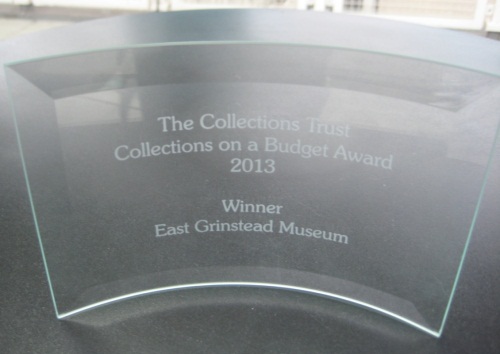
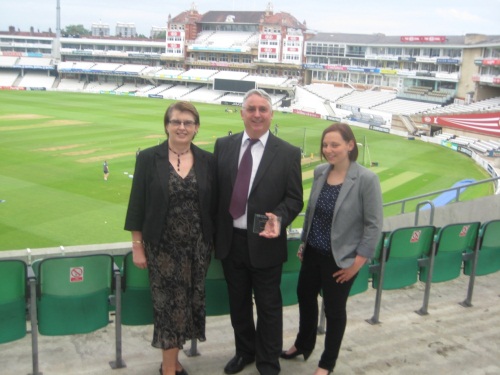
THE Town Museum in Cantelupe Road has scooped the Collections on a Budget Award given by the Collections Trust at its 2013 OpenCulture Conference.
East Grinstead’s application was called Digital Preservation Made Easy and featured the museum’s work in making all its images available for visitors to enjoy – see below for full details of the project and the work it entailed.
Congratulating the museum on its success, Council Leader Peter Wyan said it was a tribute to the work of the many volunteers who give generously of their time and their talents to preserve and retell the story of our town.
East Grinstead Museum competition entry – Digital Preservation Made Easy
THE project has been a huge challenge for a museum that only employees a part time collection officer and relies on volunteers to undertake all other roles.
This project, which started in 2007 and is still ongoing given the 16,000+ accessioned images the museum has, is not just about the fact we are scanning the images and adding the picture to our Modes catalogue, it is the innovative nature of how it is done.
With the entire image collection listed in a paper catalogue, searching for a photograph was a long task, even with a fairly comprehensive paper index. So the main challenge was to not only put the paper catalogue records onto Modes for Windows, but to find the corresponding image, scan it and then link it to the Modes record. For a small museum that is reliant on volunteers of different ages and IT abilities, making sure there were clear and simple procedures in place for documentation and cataloguing was essential, and with over 16,000 images, and only one computer licensed to use MfW, this was going to be a long task.
The Museum was able to recruit an IT professional as a volunteer. In order to make the whole process easier, he developed an in house cataloguing programme based on Modes records, which can be accessed by volunteers on any computer within the museum’s network. This means that multiple volunteers can transcribe hand written paper catalogue records onto a bespoke database from any museum computer. Our collections officer regularly runs a bespoke programme on the server to extract the most recent data stored. This programme converts new data held by the database to a (“TAG”) format which can be directly imported into Modes. As the data is exported, various data fields are converted by fixed rules, making the conversion process consistent.
As Modes records steadily increased, the task of matching and scanning the images to the records was the next challenge. Because the physical images were stored by categories (eg. transport, houses, people, etc), it wouldn’t be a simple case of going through the drawers of images and chronologically scanning the images – would a Modes record for that image even exist yet? There must be a more efficient way of managing this process.
The IT Manager created a very smart programme that, (whenever and whatever order the image had been scanned and providing it had been saved into the right folder), ‘read’ the file name of all the images in the ‘pictures’ folder and then ‘read’ the unique record numbers in the Modes export files. If the Accession number of an image matched the Accession number of a record, it would unite the two and automatically the image would appear in Modes.
A ‘Check Modes Update’ report can be run at any point which reports how many Modes records there are, how many images have been scanned in total, and how many ‘matches’ of linked records to images exist, the aim being 16,000 Modes records, 16,000 images and 16,000 matches.
Because of the efficiency of the system, it means anyone can come in at any point and just pick up where the previous person left off. The scanning and cataloguing of paper records is now a simple task because there aren’t any confusing technical procedures involved. All volunteers can contribute to the task using multiple scanners and cameras, and at any computer in the museum (and in some cases, volunteers could even access the network from home and carry on inputting catalogue records at their leisure).
Impact of the project
The impacts of this ongoing project have been multiple. The volunteers can all be involved and, because of the regular back-up system set up on the network, can all visibly see the completed records within the hour. This gives a huge sense of satisfaction and shows the volunteers that their time and work is tremendously valued.
It has also enabled improved search functions for staff, volunteers and visitors alike. As well as importing items into MfW, bespoke programmes are also used to convert data exported “from” MfW for display by the web server to any PC at the museum including the PC available in the Research Room in the Museum for everyone to use. This means that anyone can do a quick keyword search at any time and be confident that they are searching the most up to date digitised data.
This also really helps museum staff and volunteers answer the various and multiple enquiries that the museum receives about ‘whether we have a photo of…?’ The museum provides high resolution copies of images to visitors and commercial organisations and with so many images available we are able to quickly and efficiently respond to image requests, as well as being a useful source of income.
Another impact of the project is the fact that, with such high resolution copies of the images in the system that are accessible to all, we very rarely have to physically riffle through drawers and boxes. This cuts down on handling and will improve the long term preservation of the collection.
Relevance to the criteria and category
The Collections Practice Award: This award celebrates projects which demonstrate the application of innovative practice to improve the sustainability and use of collections in arts and cultural organisations.
Budget of the project
Modes for Windows £800
A4 scanner £250
A3 scanner £900
Printer £500
Purchase of the above items was funded by grants.
Next steps for the project outcome
There is still so much we don’t know about our collection and would love to build on some Revisiting Collections work we carried out in 2011. We have recently begun this through our 6 The in-house keyword search function is also a useful tool to have when volunteers are researching for exhibitions, articles and other information as it means they don’t have to use Modes. Facebook page where we encourage our users to add their own comments and knowledge to the images that we post.
We are also investigating setting up our own HistoryPin Channel to create a series of ‘Then and Now’ collections available to for the public to view and comment on. The potential to move forward and use the images and information in innovative and creative ways is very exciting and a challenge we look forward to embracing.