
Sculptor Martin Jennings talks about his inspiration for the McIndoe statue which will be unveiled by Princess Anne next Monday
1 June 2014
Please note: this news article is in our archive. Articles were correct at time of publication, but should not be relied on for accuracy after the passage of time.
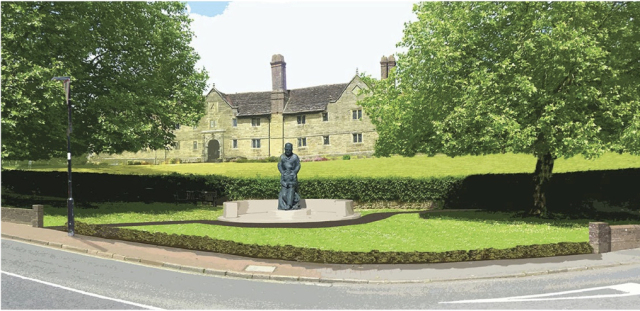
THE York stone plinth has been built, the flower beds are being planted up and the site of the McIndoe memorial statue – seen above in an artist’s impression of the finished site – just awaits the man himself.
It is hoped that the larger-than-life bronze will be winched into place on Friday, where it will remain shrouded until the covers come off next Monday when HRH The Princess Royal reveals it to the world.
The project, which has been jointly organised by the Blond McIndoe Research Foundation, the Town Council and the EGBA (East Grinstead Business Association) will change the look of the High Street forever.
This is what sculptor Martin Jennings said about his work and the inspiration behind it, when he originally proposed the design.
‘I want to make more than just a statue of the great surgeon. McIndoe’s story is inseparable from that of the Guinea Pig Club, his burned ‘boys’ for whom he was a cross between compassionate parent and strict figure of authority. So I have represented him with a patient (though not a particular person) who has burns to his face and hands but still wears his RAF uniform, as McIndoe insisted his patients should be allowed to.
‘The pilot is turning his head to look back up to the sky in which he can no longer fly but also towards his doctor for reassurance. McIndoe’s hands are on the younger man’s shoulders, suggesting the communication of his extraordinary confidence – his patients always refer in their memories of him to his absolute certainty that they would go on to lead productive lives despite the traumas they’d suffered.
‘Many of McIndoe’s patients suffered terrible injuries to their hands and “main en griffe” (claw hands) frequently resulted. After his wartime burns, my own father’s hands were fixed in a claw shape for the remainder of his adult life. I can remember when growing up how tentatively he sometimes used to hold them and how he used to stretch them when they ached. This is something I want to record in that one small part of the statue.
‘McIndoe encouraged the people of East Grinstead to involve themselves with the social rehabilitation of his patients. I’m proposing that the statue should have a continuous crescent of stone seating encircling it, so that when the people of the town sit down around it they will be helping symbolically to complete it. It seems to me to be important that this monument should be seen not just as a tribute to a great man but to his heroic patients as well and to the community that did so much to support them.’